Technology continues to change how people work, communicate, travel, and interact with the world. In 2026, several important developments are moving beyond research environments and entering practical applications. Spatial computing is creating new ways to combine digital information with physical surroundings. Quantum computing is advancing research into complex calculations that traditional systems struggle to perform efficiently. Autonomous systems are also becoming more capable through improvements in artificial intelligence, sensors, and robotics. These developments offer opportunities for businesses, researchers, and individuals. However, they also introduce challenges involving security, investment, infrastructure, and responsible use. This emerging technology 2026 guide explores the innovations attracting attention, their potential applications, and the factors that will influence their adoption. Understanding these developments can help organizations make informed decisions and prepare for a technology landscape that is becoming increasingly interconnected.
The Technology Landscape Entering a New Phase of Innovation
The technology industry is entering a period where different innovations increasingly work together. Artificial intelligence, cloud computing, advanced robotics, and connected devices are no longer developing independently. Businesses are combining these capabilities to improve operations, analyze information, and create more responsive services.One important change is the movement from experimental technology toward practical implementation. Organizations are testing solutions in manufacturing, healthcare, logistics, education, and financial services. Some applications are already delivering measurable improvements, while others remain at an early development stage.Investment is another major influence. Technology companies, universities, research institutions, and governments are supporting projects involving advanced processors, intelligent machines, and immersive interfaces. These partnerships help accelerate research and provide access to specialized knowledge.However, organizations should avoid adopting technologies simply because they attract attention. Every investment needs a clear purpose. Businesses should identify operational problems, evaluate available solutions, and measure expected benefits before introducing new systems. This approach reduces unnecessary spending and creates a stronger foundation for long-term innovation.
Spatial Computing Is Reshaping Digital and Physical Interactions
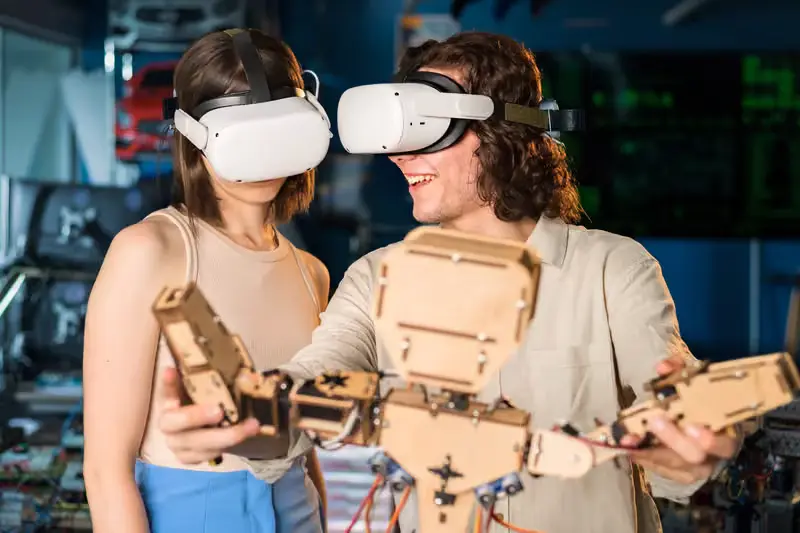
Spatial computing combines digital information with physical environments. It allows computers to understand surrounding spaces and place interactive digital elements within them. Unlike traditional screens, spatial interfaces can make digital content appear connected to real-world objects and locations.The technology includes augmented reality, virtual reality, and mixed reality. Augmented reality adds digital information to a physical view. Virtual reality creates an entirely simulated environment. Mixed reality allows digital objects and physical surroundings to interact in more advanced ways.These capabilities have applications across several industries. In education, students can explore interactive models of scientific concepts. Healthcare professionals can use visual simulations for training and planning. Architects can examine building designs within realistic spatial environments. Manufacturers can visualize equipment layouts before changing physical production areas.Spatial computing may also improve remote collaboration. Teams can examine three-dimensional models and interact with shared digital objects without being in the same location.However, successful adoption requires more than impressive demonstrations. Organizations need reliable hardware, useful software, trained employees, and clear business objectives. The strongest applications will solve practical problems rather than simply introduce another digital interface.
Immersive Interfaces and Context-Aware Experiences
Immersive interfaces allow people to interact with digital environments through gestures, movement, voice, and specialized controllers. Sensors and cameras help devices recognize physical surroundings and track user actions.Computer vision plays an important role in this process. It allows systems to interpret visual information and identify objects, surfaces, and spatial relationships. Spatial mapping then helps position digital content accurately within an environment.These capabilities can make training more realistic. For example, an employee learning to operate complex machinery could practice procedures in a simulated environment. This may reduce training risks and help employees develop confidence before working with physical equipment.Context-aware experiences provide another advantage. Digital information can respond to a user’s location, activity, or surroundings. A technician might receive instructions connected to a specific machine, while a designer could view a virtual product model from different angles.Developers must still address comfort and usability. Poor tracking, visual fatigue, complicated controls, and heavy hardware can discourage regular use. Interfaces should remain intuitive and allow users to control how much digital information appears around them.
Business Opportunities and Adoption Barriers
Businesses can use spatial computing to improve product development, maintenance, employee training, and customer experiences. Retailers may offer interactive product previews, while engineering teams can examine virtual prototypes before manufacturing begins.These applications can reduce design errors and improve communication. They may also help distributed teams understand complex projects more easily.Nevertheless, hardware costs remain a barrier for some organizations. Companies must also consider software compatibility, employee training, maintenance, and data protection. Spatial devices may collect sensitive information about surroundings, movements, and user behavior.A practical adoption strategy begins with a small pilot project. Businesses should select one process where spatial technology could deliver measurable value. They can then evaluate employee feedback, operating costs, productivity improvements, and technical reliability before expanding the investment.
Quantum Computing Moves Toward More Practical Applications
Quantum computing is one of the most closely watched areas of advanced technology. Traditional computers process information using bits that represent either zero or one. Quantum computers use quantum bits, known as qubits, which behave according to the principles of quantum mechanics.Three concepts help explain how this technology works. Superposition allows a qubit to represent a combination of possible states. Entanglement creates relationships between quantum states that cannot be described independently. Quantum algorithms use these properties to approach specific computational problems differently from conventional methods.This does not mean quantum computers will replace ordinary computers. They are designed to address specialized problems that may be extremely difficult for classical systems. Potential applications include molecular simulation, materials research, complex optimization, and certain financial modeling tasks.Pharmaceutical researchers, for example, may eventually use quantum simulations to investigate molecular behavior more accurately. Materials scientists could explore new chemical structures for batteries, electronics, and industrial applications. These possibilities could support discoveries that are difficult to achieve through conventional computational methods.Progress in 2026 is increasingly focused on reliability. IBM and University of Chicago researchers reported a demonstration involving 70 logical qubits in July 2026. Their work focused on improving error correction and verifying the accuracy of quantum computations. This represents research progress rather than proof that quantum computers are already suitable for widespread commercial workloads.
IBM Newsroom+1
For businesses, the practical strategy is to monitor developments and identify problems that could benefit from quantum methods. Immediate investments should focus on research partnerships, workforce education, and understanding potential applications rather than expecting instant performance improvements.
Research Breakthroughs and the Path to Scalability
Quantum computers face a major technical obstacle: qubits are highly sensitive to environmental disturbances. Temperature changes, electromagnetic interference, and other forms of noise can introduce errors into calculations.Quantum error correction addresses this problem by using multiple physical qubits to protect information represented by a more reliable logical qubit. This requires additional hardware and sophisticated control systems.Researchers are exploring different processor designs, improved materials, and more efficient error-correction methods. Progress in these areas is important because larger quantum processors are not automatically more useful. They must also perform calculations accurately and consistently.Scalability remains another challenge. A commercially useful system needs enough reliable logical qubits to execute complex algorithms. It also requires efficient connections, software development tools, and infrastructure capable of supporting demanding operations.Organizations should therefore evaluate quantum developments through practical indicators. Error rates, logical-qubit reliability, computational performance, and repeatable results provide more useful information than headline processor counts alone.
Autonomous Systems Are Changing How Work Gets Done
Autonomous systems use software, sensors, artificial intelligence, and connected hardware to perform tasks with limited human intervention. They can collect information, interpret their surroundings, make decisions, and respond to changing conditions.These systems are becoming increasingly important in transportation, agriculture, logistics, manufacturing, and infrastructure management. Their main advantage is the ability to perform repetitive or complex operations with greater consistency.In manufacturing, autonomous machines can move materials, inspect products, and support production processes. Agricultural systems can monitor crops, identify irrigation requirements, and assist with precision spraying. Logistics companies can use intelligent equipment to manage warehouse operations and improve inventory movement.Autonomous technology can also support infrastructure management. Intelligent monitoring systems can identify unusual operating conditions and alert maintenance teams before equipment failures become more serious.However, automation should not be treated as a complete replacement for human expertise. Complex environments often contain unexpected situations that machines may not recognize correctly. Human supervision remains essential when decisions involve safety, accountability, or significant financial consequences.
Robotics, Autonomous Vehicles, and Intelligent Machines
Robotics is moving beyond traditional industrial machines that repeat predefined movements. Newer systems combine sensors, computer vision, machine learning, and adaptive control to respond to changing conditions.Industrial robots can assist with assembly, inspection, packaging, and material handling. Collaborative robots, often called cobots, are designed to work alongside human employees in suitable controlled environments.Autonomous vehicles represent another important development. Self-driving systems use cameras, radar, lidar, and other sensors to interpret roads and surrounding traffic. Their software must identify obstacles, estimate movement, and make decisions within very short periods.Drones and autonomous delivery systems are also finding specialized applications. They can support surveying, agricultural monitoring, infrastructure inspection, and certain delivery operations.Despite these advances, reliability remains a major concern. Poor weather, unusual obstacles, sensor failures, and unpredictable human behavior can create difficult operating conditions. Businesses should introduce autonomous machines gradually, beginning with controlled environments and clearly defined responsibilities.Safety testing, emergency controls, regular maintenance, and human oversight should be part of every deployment plan. These measures help organizations benefit from automation without overlooking operational risks.
The Technologies Working Together to Accelerate Innovation
The most important technological developments often become more powerful when combined. Spatial computing, artificial intelligence, autonomous systems, and advanced computing can support applications that would be difficult to develop independently.For example, a manufacturing company could combine spatial computing with AI-powered inspection tools. Employees might view digital equipment models while an intelligent system analyzes machine performance. Autonomous robots could then complete selected material-handling tasks.Cloud computing provides another layer of support. It allows organizations to access computing resources, store information, and coordinate applications across different locations. Edge computing processes selected information closer to where it is collected. This can reduce delays in applications that require immediate responses.Advanced sensors and connected devices also improve the flow of information. They help systems understand physical conditions and respond to changing circumstances.Quantum computing may eventually contribute to specialized optimization and simulation tasks within this wider technology environment. However, it remains a developing field and should not be treated as an essential component of every modern technology strategy.Interoperability is a critical requirement. Different systems must exchange information securely and use compatible data formats. Organizations should prioritize open standards, reliable integration, and clear data ownership when designing connected technology environments.
Economic Opportunities and Industry Transformation in 2026
Emerging technologies are creating opportunities across established industries and new business sectors. Companies can use automation to improve productivity, spatial computing to support product development, and advanced analytics to make better operational decisions.Startups may benefit from these developments by solving specialized problems. For example, a small technology company could develop spatial training software for industrial workers or intelligent monitoring tools for agricultural businesses. These focused solutions may offer more practical value than attempting to compete directly with large technology platforms.Established organizations can also develop new revenue models. Manufacturers may offer predictive maintenance services, while healthcare technology providers could introduce advanced simulation tools for professional training.The employment landscape is changing as well. Demand is increasing for professionals with skills in robotics, cybersecurity, data engineering, AI development, and advanced computing. Technical expertise alone may not be enough. Employees who understand industry operations and can translate technology into practical solutions will also be valuable.Businesses should invest in workforce development before introducing major technological changes. Training programs, research partnerships, and collaboration between technical and operational teams can reduce implementation difficulties.The economic benefits will not be distributed equally. Organizations with better infrastructure, skilled employees, and access to investment may adopt advanced systems faster. Smaller businesses may need affordable solutions and external partnerships to participate in this transformation.
McKinsey & Company+1
Security, Ethics, and Regulatory Challenges
Technological progress creates responsibilities that organizations cannot ignore. Spatial computing devices may collect information about physical environments, movements, and user interactions. Autonomous systems can gather operational data and make decisions that influence people and businesses. These capabilities raise important privacy questions.Cybersecurity is another concern. Connected machines and intelligent infrastructure can become targets for unauthorized access. A compromised autonomous system could interrupt operations or create physical safety risks.Organizations should apply security measures throughout the technology lifecycle. Strong authentication, encryption, access restrictions, regular software updates, and continuous monitoring can reduce exposure. Security should be included during system design rather than added after deployment.Ethical challenges also require attention. Automated decisions may contain errors or reflect biases in training data. When a machine makes an incorrect decision, organizations need clear processes for investigation and accountability.Quantum computing introduces an additional security consideration. Powerful future quantum computers could threaten some existing public-key encryption methods. Businesses should begin evaluating post-quantum cryptography and planning the migration of sensitive systems. This is a long-term preparation issue, not a reason to assume current encryption is already broken.Regulatory requirements will also influence adoption. Companies operating across multiple countries must consider different standards for data protection, AI governance, workplace safety, and automated transportation.Responsible innovation requires transparency and human oversight. Organizations should explain how important systems operate, identify who is accountable, and provide ways to challenge consequential automated decisions.
How Businesses and Individuals Can Prepare for the Next Technology Wave
Preparing for emerging technology does not require every organization to purchase advanced hardware or build experimental systems. A more effective approach begins with understanding business needs and evaluating where innovation can deliver measurable benefits.Businesses should start by identifying operational problems. These might include high maintenance costs, inefficient training, slow product development, or repetitive manual tasks. Once priorities are clear, decision-makers can compare available technologies and assess their suitability.Pilot projects provide a practical way to test assumptions. A company could introduce an autonomous inspection system in one production area or test spatial training with a small employee group. Results should be measured against clear indicators such as operating costs, error rates, training time, and productivity.Infrastructure readiness also matters. Advanced systems may require reliable connectivity, updated hardware, secure data environments, and integration with existing software. Organizations should assess these requirements before committing to large investments.Employee preparation is equally important. Training should cover technical operation, cybersecurity, data protection, and the limitations of automated systems. Employees also need opportunities to provide feedback during implementation.Individuals can prepare by developing digital literacy and understanding how emerging technologies affect their industries. Learning about AI, robotics, cybersecurity, spatial interfaces, and data management can improve career flexibility. Professionals do not necessarily need to become specialized engineers, but they should understand the opportunities and risks associated with the tools they use.The most practical strategy is continuous learning. Technology changes quickly, so organizations and individuals should regularly review developments instead of relying on a single forecast or investment decision.
Conclusion
Emerging technologies in 2026 are creating new possibilities for computing, digital interaction, and automated operations. Spatial computing is connecting virtual information with physical environments, while quantum research is advancing toward more reliable specialized calculations. Autonomous systems are also transforming manufacturing, transportation, agriculture, and other industries. However, these innovations come with challenges involving cost, scalability, cybersecurity, privacy, and workforce readiness. Businesses should approach adoption strategically by identifying real operational needs, testing solutions through pilot projects, and preparing employees for new responsibilities. Individuals can benefit by developing digital skills and staying informed about technological changes. The future will not be shaped by innovation alone. It will depend on how effectively organizations combine advanced capabilities with responsible decisions, practical implementation, and human oversight.